

A webinar by Africa Research and Impact Network (ARIN), with practitioners from Uganda, Kenya, Ethiopia, and Somalia recently surfaced an argument that rarely makes it into the formal conference circuit: the financing is not the binding constraint. What comes before the financing is.
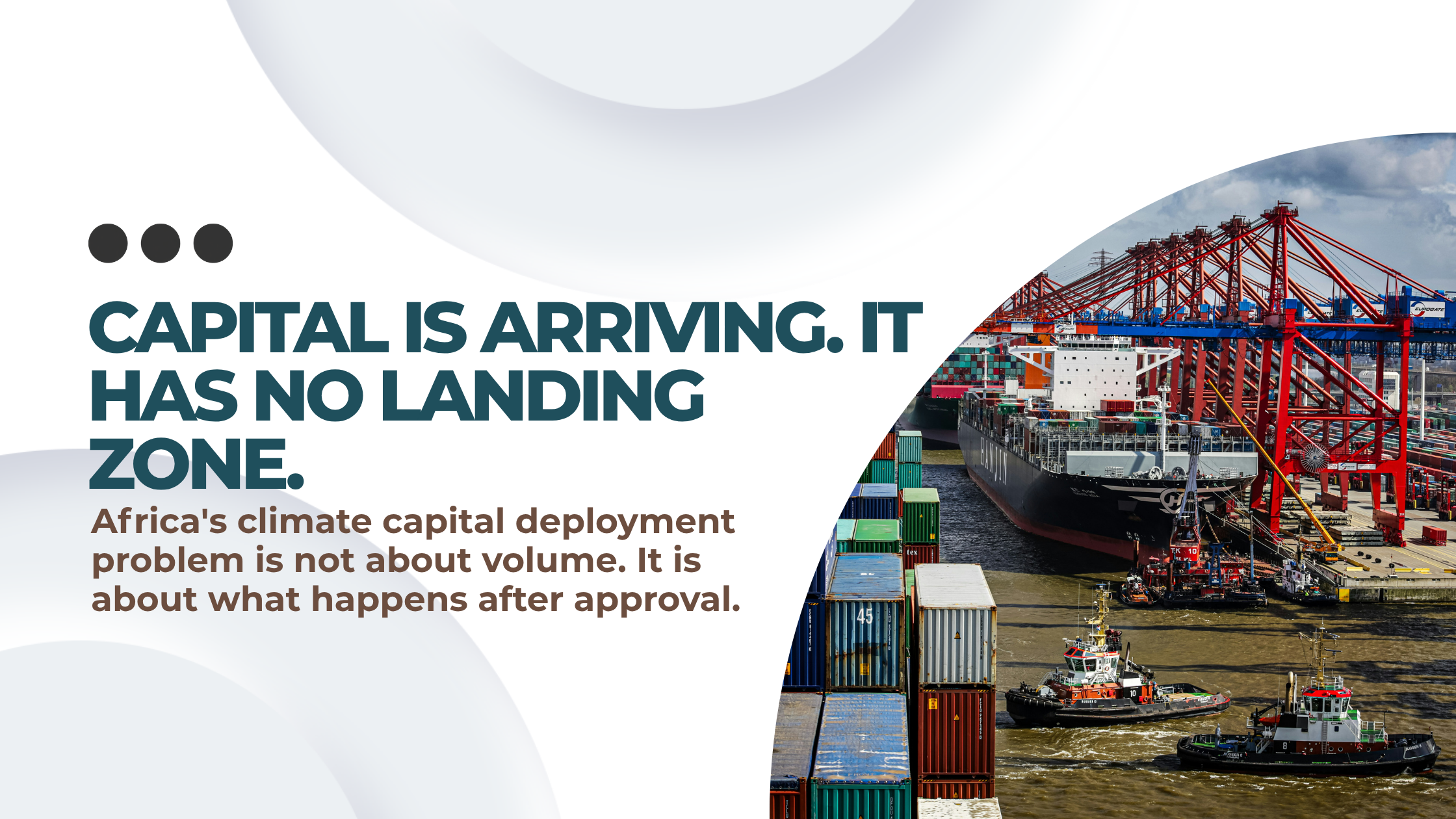
Africa received approximately $30 billion in climate finance in 2021-2022. Yet, only 14% came from the private sector. The standard diagnosis is that private capital sees Africa as too risky. But the practitioners in that room were pointing at something different. Capital is being approved and disbursed. It is not deploying. The problem is not at the entry point. It is at the landing zone.
Three things from that conversation deserve more attention than they are getting.
Financed assets are sitting idle
Kenya’s Youth Industry License Initiative made an argument that should stop every DFI programme officer mid-sentence: the primary challenge in their market is not lack of capacity or funding. It is underutilization of what already exists. Trucks, equipment, and processing fleets have been financed. They sit idle because their owners cannot access consistent project pipelines, procurement systems, or off-take linkages.
The capital event already happened. The deployment did not follow.
This matters because most de-risking conversations start at the wrong end. A guarantee facility reduces the cost of a loan. It does not create a project pipeline for the borrower to enter. If the constraint is not the cost of capital or the collateral gap, additional financing instruments do not solve anything. In some cases, they distort the market further. Several participants flagged that unregulated grant instruments are already creating pricing distortions in clean energy sectors, making it harder for commercial intermediaries to build sustainable product lines.
The implication for DFIs and commercial banks designing climate windows: the question worth asking before the next facility is structured is not ‘what is the right instrument?’ It is ‘what does the borrower need to actually deploy the capital once it arrives?’
The loan product is the last thing you build
Centenary Bank Uganda offers the clearest available evidence of what the enabling conditions work actually looks like. Their first climate lending programme, the Electricity Rural Transformation programme, known as ERT 1, failed. Not because the financing structure was wrong. Because the market conditions were not there: no adequate installer network, no product-market fit, no tracking systems.
ERT 2 worked. The bank rebuilt its approach with technical assistance, qualified energy service company partnerships, and loan products designed around how rural borrowers actually access and use energy assets. They embedded ESG targets into staff balanced scorecards. They installed solar systems in 10 of their 83 branches before asking clients to trust the technology. They established a dedicated sustainability unit. The portfolio now stands at $2.7 million with over 1,900 cases financed in the past year.
None of those investments are financing innovations. They are organizational and market-building investments that made the financing work. The loan product was the last thing they built, not the first.
Most blended finance design skips this sequence entirely. Technical assistance programmes focus on loan officer training and credit assessment tools. They do not fund installer ecosystem development, after-sales service networks, or the organizational transformation required to embed climate mandates into day-to-day lending decisions. Then they report low uptake and attribute it to weak pipeline.
The pipeline is weak because no one built it. That is a design choice, not a market failure.
The infrastructure problem sits upstream of every transaction
Zoom out further and the constraint becomes systemic. Africa has more than 52 countries. Very few of them have approved national green taxonomies, the classification frameworks that define which economic activities qualify as environmentally sustainable.
Without a taxonomy, the mechanism breaks at the institutional investor level. A pension fund or insurance company cannot classify a green asset on its balance sheet without a regulatory definition of what green means. It cannot report against a sustainability mandate it cannot measure. It cannot move capital into a category that does not formally exist, even when the underlying project is sound and the risk-return profile is acceptable. The instrument does not reach the transaction because the classification infrastructure was never built.
This is upstream of everything. Guarantees, concessional tranches, blended structures, these instruments are designed to make individual transactions viable. A taxonomy makes whole asset classes viable. The absence of one in most African markets means institutional capital, the deepest and most patient pool available, cannot participate at scale regardless of how well individual deals are structured.
The conversation about African climate finance is stuck at the instrument level. Practitioners and programme designers are debating the right blend of grant, concessional loan, and guarantee for each facility. That debate matters. But it is happening one layer below the actual constraint.
What this means in practice
For DFIs and commercial banks with climate mandates, the implication is uncomfortable but specific. Technical assistance programmes need to go further upstream. Pipeline development, installer and service provider ecosystem building, and active advocacy for national taxonomy frameworks are not peripheral to the financing work. They are the financing work. Without them, the next facility will face the same uptake problem as the last one.
Centenary Bank did not wait for the ecosystem to appear. They built parts of it themselves, demonstrating renewable energy in their own branches, qualifying installer partners, training their own staff. That level of institutional investment takes time and resources that most climate lending programmes do not budget for. It should.
The practitioners who were most effective in that room were not the ones with the best financing structures. They were the ones who had spent time one layer below the transaction, building the conditions that allowed the transaction to work. That is where the leverage is. That is also where the investment is not going.
Climate Finance & Enterprise Development Associate — East Africa Hub
AfriCGE | African Centre for a Green Economy
Finance & Markets Policy Lead – Africa
Green Finance Hub | Climate Policy Intelligence & Advisory Group (CPIAG)